
Unpaid and Excluded: New Book Exposes Constitutional Battle Over Apartheid-Era Civil Servant Pensions
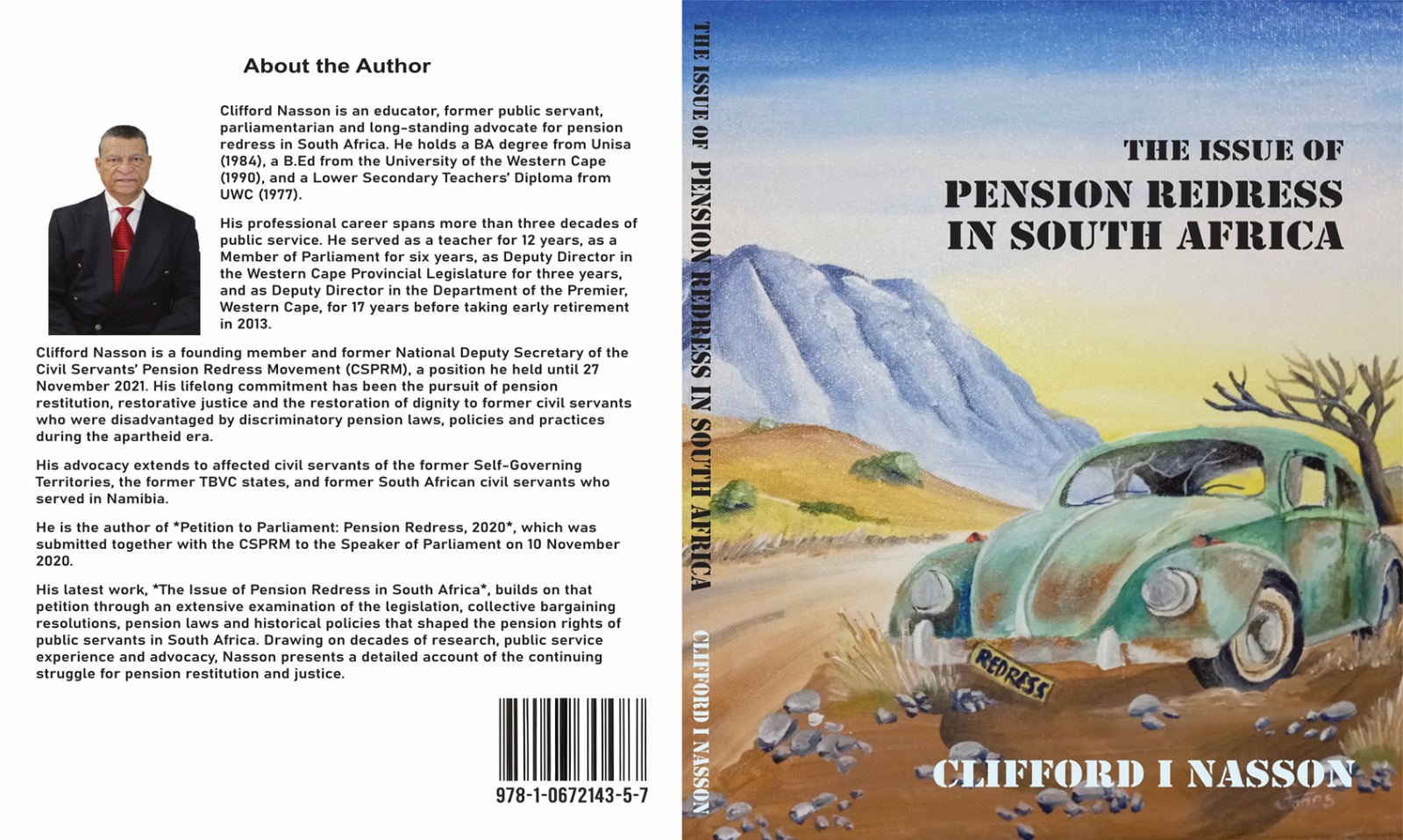
Thousands of civil servants who endured systematic discrimination under apartheid remain locked out of pension restitution, a decades-long injustice unpacked by author Clifford Nasson at the launch of his new book, ‘The Issue of Pension Redress in South Africa’, in Durbanville on 14 November 2026.
The book provides a detailed historical account of the discriminatory labour practices inflicted on female teachers and public servants during the 1960s, 1970s, and 1980s under the former apartheid government.
Nasson highlighted the human rights abuses and humiliation female educators faced simply for getting married. He cited the repealed Coloured Persons Act (Act 47 of 1963), under which Section 15(1)(g) empowered the Minister of Education to dismiss a female teacher upon marriage. Sections 16 and 17 went even further, stipulating that a female teacher who married had to be formally charged with misconduct.
Turning to the post-1994 democratic era, Nasson examined Resolution 7 of 1998, adopted on 2 September 1998 in the Public Service Co-ordinating Bargaining Council (PSCBC). While the resolution made provision for pension restitution, it imposed two strict qualifying criteria: applicants had to have suffered discrimination under apartheid, and they had to still be in the service of the State on 2 September 1998.
It is this second requirement that sparked a nationwide campaign by thousands of excluded former civil servants who suffered the exact same apartheid-era discrimination, yet were disqualified from receiving compensation, a struggle that still continues today.
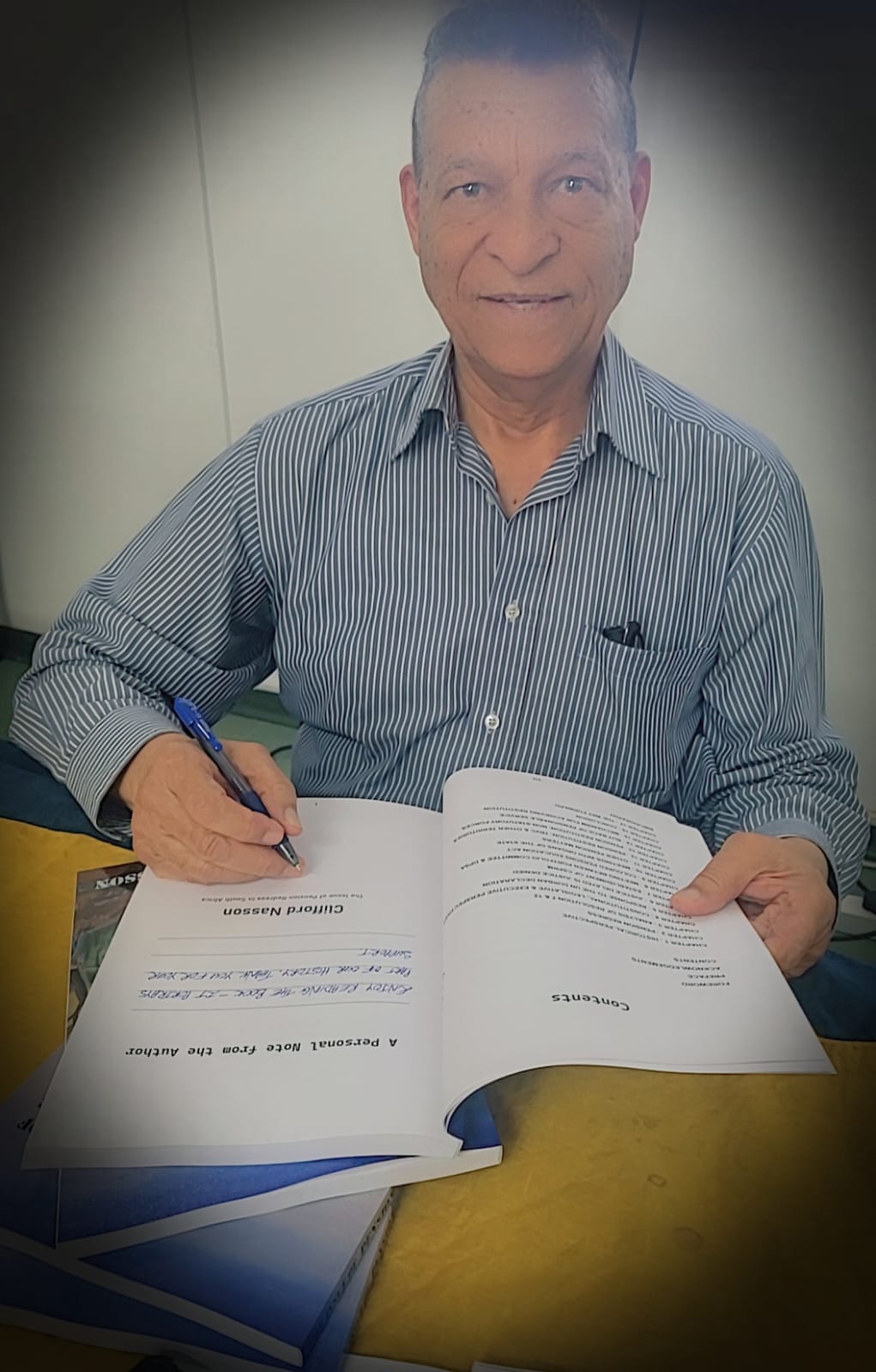
Author Clifford Nasson during the book signing. Photo: Clifford Nasson.
Nasson also pointed to troubling discrepancies in the payouts that occurred. During February and March 2019, qualifying former civil servants received cash restitution payouts of roughly R300,000 to R600,000 from the Government Employees Pension Fund (GEPF). According to the Minister of Finance, between R8.2 billion and R8.7 billion was allocated for payout to 65,105 individuals out of 150,444 applications received.
However, many former civil servants who were officially notified that their applications had been approved have testified that they never received their promised funds. According to Nasson, this constitutes a serious misrepresentation that runs counter to Section 33 (“Just Administrative Action”) of the Bill of Rights in the 1996 Constitution of the Republic of South Africa.
Testing the exclusion criteria against the Bill of Rights, Nasson argued that barring pre-1998 former employees may violate Section 9 (“Equality”) as well as Section 36(1) (“Limitation of Rights”).
He also references a televised discussion on the programme Klop, in which host Heinrich Wyngaard interviewed PSCBC chairperson Frikkie de Bruin and then-chairperson of the Civil Servants Pension Redress Movement (CSPRM), David Jantjies. During the broadcast, De Bruin maintained that the PSCBC had acted within its mandate when approving the restitution framework. While Nasson conceded this procedural point, he invoked Section 2 of the Constitution (“Supremacy of the Constitution”), which declares that any law or conduct inconsistent with the Constitution is invalid. On this basis, he concluded that Resolution 7 of 1998, along with parts of Resolution 12 of 2002, may be unconstitutional.
Finally, Nasson explored whether securing justice for excluded public service workers remains achievable. Under Section 184(2)(b) of the Constitution, the South African Human Rights Commission (SAHRC) holds the mandate to take steps to secure appropriate redress whenever an investigation confirms human rights violations.
This duty is reinforced in the Preamble and Sections 13(3) and (4) of the South African Human Rights Commission Act (Act 40 of 2013), which empower the Commission to act, including through litigation, when rights have been infringed. Nasson has formally appealed to the SAHRC to launch a full investigation and pursue legal action if necessary to finally deliver justice to South Africa’s excluded civil servants.
In what was an eventful afternoon full of insight, special guests concluded with a raised awareness on the question of Pension Redress. Many in attendance, having a public service background, queued to get their hands on a copy of ‘The Issue of Pension Redress in South Africa’. The book can be ordered from Angela at 082 397 7875 or Clifford at 082 804 7196; email: cliffordnasson@gmail.com.



.jpg)






.gif)