
Fear on the Commute: Cape Town Commuters call for Safer Public Transport
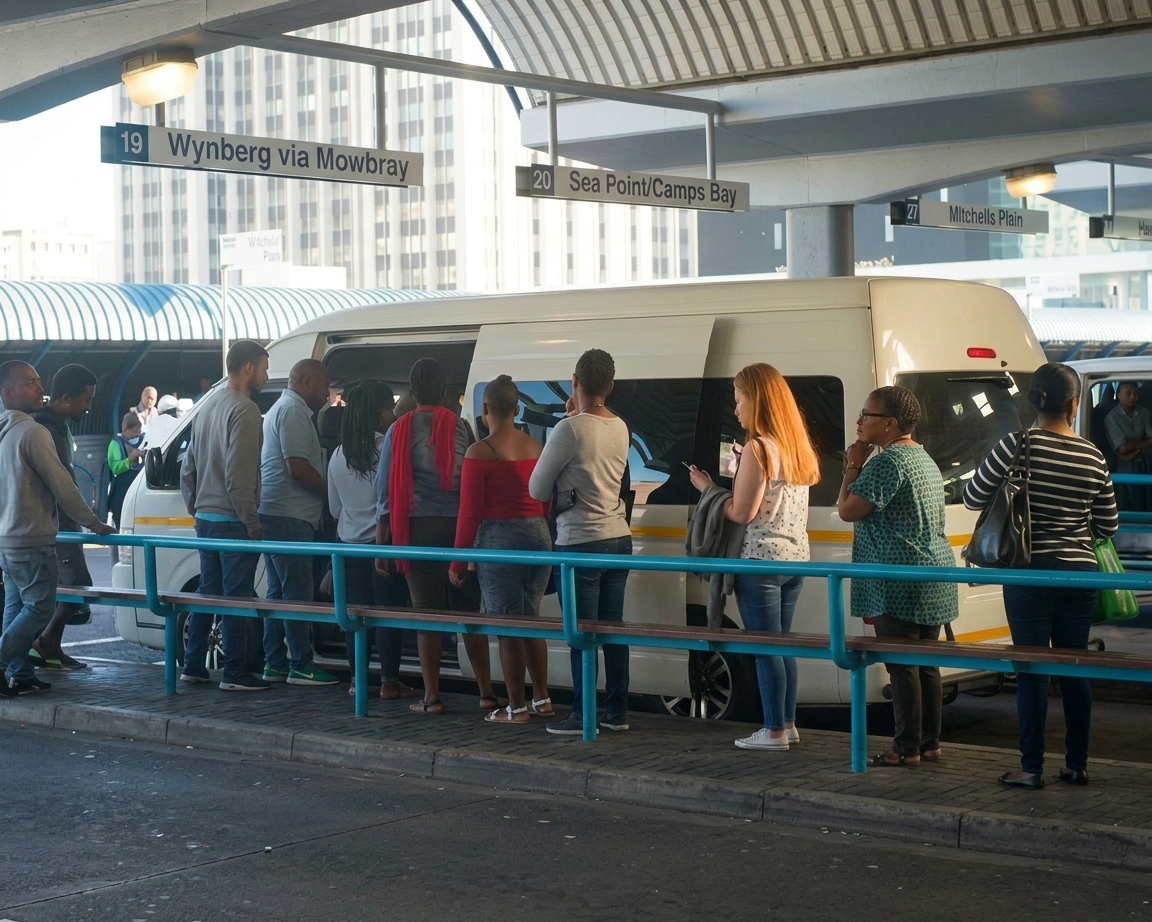
For thousands of Capetonians travelling from the townships, the Cape Flats and the suburbs to work, university and other destinations, public transport is a daily necessity. But for many commuters, getting from point A to point B also means navigating crime, security concerns, and frustrating delays when emergency help is needed.
Aphelele, a daily commuter, considers the MyCiTi bus service the safest option due to its visible security and law-enforcement presence. Minibus taxis, however, tell a different story.
“Taxis are the most unsafe,” she said.
Her concerns are rooted in personal experience. While trying to board a moving taxi one day, Aphelele slipped and fell. Neither the driver nor fellow passengers stopped to help her.
“I fell while trying to get in. Did they attend to me? No. Instead, they left me there and said, ‘You can’t jump out of a taxi while it’s going.’”
Though she didn’t report the incident, it fundamentally changed her routine. Aphelele now avoids taxis wherever possible and even asked her employer to adjust her shift so she could skip morning taxi commutes.
Jennifer Kalu, who regularly uses both taxis and buses, has faced even graver threats. During her first year at university, she was travelling in a taxi when an assailant hurled a brick through the driver’s window and threatened the driver with a firearm. A passenger was injured in the chaos.
The terrifying ordeal made Jennifer far more vigilant, though she had no choice but to keep using taxis. Commuters, she noted, often become dangerously accustomed to routine violence, brushing off traumatic incidents to simply get on with their day.
She is calling for heightened, visible security around taxi ranks, bus stops, and known crime hotspots, alongside streamlined emergency reporting and rapid response systems.
SAPS and City Outline Safety Measures
The South African Police Service (SAPS) in the Western Cape acknowledged that robbery, theft, and assault remain persistent threats around major transport hubs. Police stated that officers conduct regular patrols, crime-prevention operations, stop-and-searches, and targeted interventions, though they declined to disclose specific deployment hotspots due to operational security.
Meanwhile, the City of Cape Town noted that public transport facilities are uniquely vulnerable to petty crime, armed robbery, gang activity, vandalism, and drug peddling due to their open access to the general public.
To combat this, the City employs a layered safety approach combining dedicated law enforcement, contracted security personnel, and CCTV surveillance. A specialized Transport Enforcement Unit is currently deployed at three major public transport interchanges (PTIs): Joe Gqabi in Philippi, the Cape Town Station Deck, and Bellville.
Authorities urge commuters who witness crimes to report them immediately to SAPS on 10111, the City’s Public Emergency Communication Centre on 021 480 7700, or to on-site security where available.
For commuters like Aphelele and Jennifer, however, safety requires more than mere advice to stay vigilant. Their stories underscore a stark reality: public transport fears dictate everything from working hours and daily routines to how ordinary Capetonians navigate their city.






.gif)